
Title Vishnupuram | Author Jeyamohan |
Publisher Vishnupuram Publications | Year 1997 |
I first encountered Vishnupuram after meeting Jeyamohan at the Madurai Book Fair in 2006. I had admired his earlier work and arrived ready with comparisons and praise, but our conversation took an unexpected turn. “Have you read Vishnupuram?” he asked. I had not. “It’s a difficult book,” he said, before moving on to something else. The remark stayed with me. He had spoken about it the way people speak of places that exist just beyond reach.
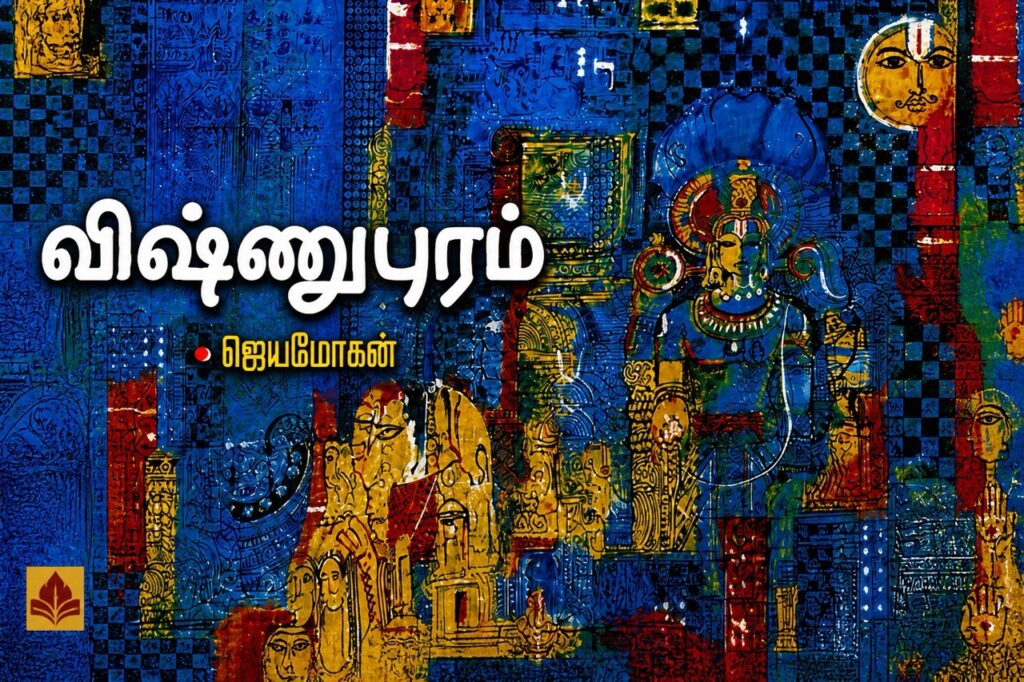
Vishnupuram is one such place: beyond the Priyadhara River, beyond forests dense with poisonous growth, guarded by ascetics whose presence itself seems dangerous. More people drown trying to reach the city than ever arrive. It may not exist at all. It may have been imagined by those desperate enough to need it. The novel introduces this uncertainty early and never resolves it.
The city has a moat, like any fortified settlement of the fifth century. It is filled not with water but with white liquid sand. Those who have not learned the novel’s fierce and exacting language cannot cross it. They turn back empty-handed. Those who do cross find that whatever they lay their hands on inside is beyond price.
The novel moves through a vast inheritance of philosophical thought: Vedic, Jain, Buddhist, Nyaya, Mimamsa, Madhyamika and beyond. Every philosophy grows by rejecting the one before it, yet remains rooted in what it rejects. The root persists beneath the growth. No tradition achieves a clean break. Each system is established with care, then exhausted with equal care. Then the next one begins. No philosophy is allowed to win. No philosophy is allowed to simply lose. Every tradition quietly knows this about itself, which is why each keeps refining, keeps adding one more commentary to what is already endless. What this endlessness points toward is not outward, toward system or argument, but inward. The great knowledge at the center of all knowledge, this tradition holds, is knowing oneself. Truth, the novel insists, never gets caught in argument. If it did, you could reach wisdom through chess.
The philosophy is not what the novel is finally about. The grief beneath it is.
Vishnupuram is full of people who have gone to the end of something and found the end unsatisfying.
An elderly monk spends his life retracing the footsteps of the great scholar Ajita. He crosses every terrain, reads every commentary, memorizes every disputation. He arrives finally at Ajita’s victory monument and understands, with the clarity that only total exhaustion produces, that the whole enterprise was madness. He walks away behind a black dog.
Bhavattar, the city’s chief scholar, has mastered every system of knowledge his civilization produced. He ends up lying on the floor, weeping, asking his grandson to call him “grandfather”. Not teacher. Not sage. Just grandfather. The ordinary word is the only thing left that feels real.
Vishnudhatta inherits all of his father’s learning. He concludes that knowledge is a staircase. It takes you somewhere, yes, but only to the discovery that you are now on a landing with no ceiling in sight, staring at another staircase. He becomes a cremation-ground ascetic and gives up.
And Ajita himself, the conqueror, the logician who bested Vishnupuram in debate and was crowned with the ring of the knowledge-throne, dies alone in a palace where there is no one left to bring him water.
But the grief is not confined to scholars. A poet who cannot master desire finds his way to a courtesan and returns to write a great verse. His own guru, who has never permitted himself desire, weeps for pleasures he will never know. A housewife loses her son and becomes a wandering devotee. A courtesan ascends to the knowledge court. A low-caste girl, adopted by a nobleman, dies in fire and becomes a goddess in a forest grove. The novel moves through every kind of person, every kind of longing, every kind of loss. No life in it is spared. No life in it is mocked.
What unites them is not philosophy or fate but the particular shape of human longing, which the novel shows to be the same whether it is carried by those who debate in wisdom courts or those who are never interested in them.
These are not cautionary tales. The novel does not mock these people. It does not comfort them either. It simply observes, with the steady attention of a work that trusts its readers to tolerate ambiguity, as each of them fails in their own precise and inevitable way.
The architecture of the novel is built to hold exactly this weight. Built on the principle of a half-wheel, it can be entered from any direction and read against itself. Every argument contains the seed of its refutation. This could be evasion. It could be the most honest account available of how thought actually works. The book is, deliberately, both.
What holds it together is the prose. It moves between registers the way a river moves, rapids and stillness and rapids again, but always the same river. The Sona runs red through the novel’s geography. Iron-bearing rock, say the rationalists. Accumulated violence, say the elegists. Both explanations are given. Neither is taken back. This is how Vishnupuram holds its competing truths, not by reconciling them but by letting them run in the same current, visible at the same time to anyone patient enough to stand on the bank and look.
But the river itself does not care who is watching. This is where the novel’s understanding of time begins. Time, it proposes, is not something that passes around us. It is something the mind produces. When consciousness begins to sort events, to place them before and after each other, time comes into being. When consciousness changes, time changes with it. All mathematics begins at zero and ends at zero, with infinity pressing in from both sides. What we measure is only the narrow interval we have trapped between those two zeros. To measure time is to measure an illusion with another illusion. The seasons, Hemantha and Vasantha and Grishma, have always been telling their stories. We are perhaps only names inside those stories. If time is a circle, humanity is the crab running along its edge, convinced it is going somewhere.
Seeing Jeyamohan again, I could only say: I had never encountered philosophy this dense within a work of fiction—it moved me to tears. He paused for a moment and replied, “That’s because the philosophy emerges from within the fiction. That’s why”
On another occasion, standing inside a great cathedral, he said that a large novel is like a vast temple: however many times you visit, you cannot take in the full measure of its detail. The next time you return, something new will catch your eye. I have found no better description of what it means to read this book. You come back when the light has changed. You come back because you are different.
By the end, Vishnupuram is a ruin. The gleaming city of the early chapters has become an overgrown village. The great ring of scholarship, passed ceremoniously from one mind to the next across centuries, is eventually fitted to a harmless madman wandering in a grove. The wheel turns. What was magnificent becomes ordinary. What was sought becomes a rumor of itself.
Whoever chooses the worldly life grows dissatisfied and longs for the other. Whoever renounces it carries the same longing in reverse. A person is born, grows, spends their life caught between the two, and perishes in that unresolved turning. Appearance, growth, decay, and then a great emptiness. Out of that emptiness, appearance again. Humans and cities and stars and planets, all following the same arc.
Vishnupuram is a dream. Reality exists on both sides of it. A reader can turn in either direction upon waking. Where the novel finally points, after everything it has passed through, is not toward any system or settlement or hard-won peace. It points toward that turning itself. Toward the willingness to keep moving after the city has fallen and the questions have outlasted every answer given for them.
These questions do not belong to Vishnupuram. They were here before it. They will continue long after.