
When a war between the military of an oppressive government and an armed liberation movement fighting against it has gone on for more than thirty years and hits its most violent peak, what happens to the ordinary people stuck in the middle? What must it feel like for those people , ground down by war across three generations, losing their lives and everything they own, forced to keep running with nowhere to go?
Some of them may have genuinely believed in what the liberation movement stood for and picked up weapons, or helped out behind the scenes without actually fighting. Some may have joined rival groups because they had different political beliefs. Others may have wanted nothing to do with the war at all, just trying to hold onto whatever normal life they could in their hometown. And some tried to get out completely, escaping to faraway countries and starting over.
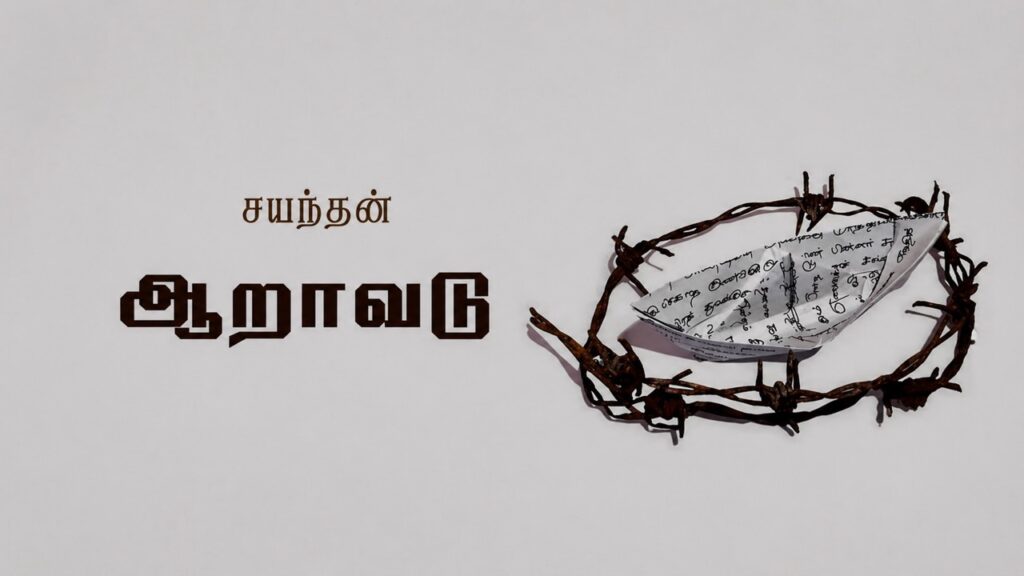
But no matter which of those paths they chose, none of them came with any guarantee they’d make it out alive. When a bullet could find you at any moment, what does life even mean? When the ground you’re standing on could turn into your grave at any second, how do you judge the things people do, their wins and losses, their betrayals and moments of loyalty, the rules they follow and the punishments they take? The novel Aaraavadu by Sayanthan feels like an honest attempt to wrestle with exactly those questions.
Set during the liberation war in Eelam, the novel is about how war and violence tore apart the lives of everyday people. Instead of just recording what happened on the outside, it digs into the feelings and inner conflicts of the people who actually lived through it. The book looks honestly at the trust people placed in the Liberation Tigers movement, some of the battles they won, the overreach of the Indian Peace Keeping Force, and the brutal policies of the Sinhala government, and it does all of this without pushing any single political agenda. It criticizes everybody.
A lot of writing about the Eelam war comes with an agenda , either fully behind the liberation movement or fully against it. Araavadu sits somewhere in between and gives you a complicated, honest look at what war actually costs in human terms. That’s what makes it feel less like a political statement and more like real literature.
The main character is Amudan, a former Tamil Tigers fighter who lost both legs to enemy fire and now works on the political side of the movement. The story kicks off with him trying to sneak out of Sri Lanka on an illegal boat to Italy because of a woman he loves, then slowly opens up to take in the Tigers, the rival groups fighting against them, the Sinhala and Indian militaries, and the governments behind all of it. It’s a lot of moving parts, and together they build a messy, complicated picture of what that world actually looked like.
Amudan is nothing like the typical soldier you get in war stories. He’s not some warrior born ready for battle, charging into combat with honor and purpose. He’s a guy who went looking for someone who stole his sandals, got caught by the Indian military, nearly died, and survived by giving up the people the soldiers were hunting. Then he joined a rival armed group because they threatened him. Then he got captured by the Tigers, gave up his own commanders to save himself, ended up becoming a Tigers fighter anyway, and finally ran from them too , all to get to Italy for love. And yet, the way Sayanthan writes about what Eelam was like and what the people there went through makes you desperately want Amudan to make it out. That’s the real achievement here.

One of the strongest things about this novel is how clearly it shows what happens to a liberation movement over time. Sayanthan does a sharp job of tracing how a group that picked up guns to fight for its people’s rights slowly turns into its own kind of government, collecting taxes, demanding total obedience. The movement that once had the people’s love and trust ends up pushing those same people away. There’s a part in the book that points out how every battle the Tigers won got a name and got plastered across the news, while every battle they lost just disappeared, never reported, never mentioned. That observation pulls back the curtain on how war gets sold to the public. And it applies to pretty much every movement that ever grabbed power, no matter what they called themselves: hide the losses, inflate the wins.
The criticism Sayanthan voices through the character of Nehru is razor-sharp. Nehru points out that the Tigers didn’t push for peace even when they had the upper hand, that they created a huge distance between themselves and the people they were supposed to represent, and that they stuck their nose into deeply personal things like caste, relationships, and who people could marry. These don’t come across as outside attacks, they feel like hard-won, painful observations from someone who was actually there. When Nehru says to Amudan, “How happy would these people’s lives have been if your movement had simply never existed,” that hits hard. Amudan has no real answer. He just gets angry and falls back on “the leader knows everything,” which is its own kind of answer.
Aaraavadu isn’t just political though, it’s also about real people and what war does to them up close. On the illegal boat heading to Italy, there are not just Tamil refugees but also around ten Sinhalese passengers. That detail says a lot about where the novel is coming from. When Amudan asks one of them, “We have every reason to run. What are you running from?,” the answer from Pandara, who’s deserting the Sinhala military to seek asylum in Italy, genuinely shakes you.
It’s a simple moment, but it says something huge: ordinary people are trapped on both sides of this thing. Tamils are running for their lives; Sinhala young men are stuck in a war they never asked for and are trying to get out too. The two of them, on that boat, cut right through all the politics and get to something just plain human.
Some of the images in the novel stick with you long after you finish. Young Amudan watches a storm cloud pull water up from the sea and asks his uncle what happens to the fish. “They get sucked up and swallowed too,” his uncle says, and that image quietly becomes the heart of the whole book. When war gets hungry enough, everybody goes down with it. Nobody chooses to be swallowed. They’re just in the water.
The way the book is put together is worth paying attention to. Each chapter feels almost like its own short story, but by the end Sayanthan has stitched them all into one complete picture. Things that seemed random at the start turn out to be connected. That said, the early sections can feel a little choppy and hard to follow as one continuous story. And every now and then the writing gets a little stiff, with phrasing like “his reply was as follows” or “and thus this chapter ends,” which feels out of place given how intense everything else is. But Sayanthan’s voice, dry, ironic, willing to poke at everyone, keeps pulling you forward.
The ending is one of the most memorable things about the book. Amudan’s fiberglass prosthetic legs wash up on a shore, and eventually make their way to an Eritrean liberation fighter, also an amputee, still fighting his own war against Ethiopia on the other side of the world. It’s a strange image, but it lands. Those legs become a symbol of something that doesn’t stop when one war does, it just moves somewhere else, finds the next open wound.
Which is exactly what the title is about. Aaraavadu means a wound that won’t heal. Not just the wound in Amudan’s body. Not just the grief of one community. The Eelam war may be officially over, but its damage is still alive in the people who lived through it, and in their kids, and in their memories. This novel is that wound refusing to be forgotten. It’s a burn that goes all the way down, and never, ever closes.