
When I read Mary Oliver’s poem “The Ponds,” I keep returning to her wish, “to be willing / to be dazzled.” She sees what is before her, yet wants to “cast aside the weight of facts” and remain open to wonder. I think of that willingness when I read Suneel Krishnan’s Neelakantam.
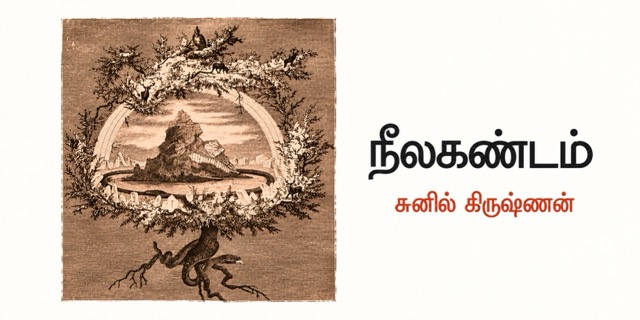
Neelakantam is set in a rapidly modernizing India, where every problem seems to have a multilayered, price-tagged solution. Yet Suneel shows how young people, caught between contemporary privilege and primal struggle, can still find themselves paralyzed by life’s most fundamental crises. Through Senthil and Ramya, the novel looks beyond the practical struggles they face to a more sobering question: what do they expect love to give them?
The novel opens at a hospital, where Senthil waits with his autistic daughter, Varshini, to see a specialist while his wife, Ramya, is kept away by the demands of her work. Senthil and Ramya married for love across caste lines. Their IT careers gave them financial security, but the pace and demands of those lives also stand in the way of their hope for a child. As their attempts to conceive fail, disappointment begins to disturb the harmony of their marriage. Intimacy, once an expression of desire, becomes bound to the obligation to conceive. The novel follows the psychological toll of that change, showing how differently Ramya and Senthil experience the same pressure.
Ramya finds herself yearning for the family she severed ties with just to be with Senthil. The novel suggests that bringing a child into the world was her desperate bid to heal the loss of those broken relationships. Subsequent delays and failures plunge her into a state of deep distress. Suneel traces, with unsettling precision, how her shattered expectations curdle into resentment toward Senthil, so that even his most mundane actions become fresh triggers, and her love is masked by bitterness.
Senthil’s collapse is quieter, and Suneel renders it with unusual candor. Unable to fulfill Ramya’s longing for a child, he finds the pressure turning into a barrier to intimacy itself. In a misguided bid to test his masculinity, he seeks out a sex worker, only to learn that the woman is pregnant. It is one of the novel’s most daring scenes, and Suneel resists easy irony: the moment does not mock Senthil but quietly dismantles his belief that longing, effort, and suffering ought to bring about the life he and Ramya desire. Here the novel is at its most unsparing, and most humane.
Faced with the persistent wall of childlessness, Senthil and Ramya ultimately turn to adoption. What I sense beneath their decision is raw emotional impulse rather than any grounded psychological maturity or preparedness. Suneel does not soften this; he draws out the darker side of their desperation, where a child risks becoming the answer to her parents’ needs. For Ramya, adoption is a desperate bid to grow her lineage below, a way to mend the spiritual void left by a broken lineage above after she severed ties with her parents for love. Senthil agrees largely out of profound guilt, carrying the heavy weight of his perceived failure to give Ramya a biological child, and the knowledge that his union with her is what cut her off from that crucial parental support system when she needed it most.
As the novel moves from the couple’s struggle to conceive into their daily life with Varshini, it follows their difficult adjustment to parenting her. Senthil and Ramya search her small behavioral changes for reassuring signs, sometimes giving those moments a significance they may not bear. Their interpretations reveal both a need for comfort and the expectations they brought to parenthood. Alongside the demands of their routine, the novel shows how slowly they begin to understand Varshini’s autism, and how their earlier disappointments continue to shape what they notice.
The narrative then opens a world that cannot be contained by her parents’ expectations. In Akshara, the apartment complex where Varshini lives, Nemo, Z, and Dora become guides, while Chhota Bheem, Pac-Man, and a sea turtle enter the landscape of her play. These figures give the reader another way to encounter her experience. For a time, the novel’s attention rests on the connections Varshini makes within her own world.
The novel examines these modern family struggles through myths, Puranas, and fables. In recurring interludes, the Vethalam presents King Vikram with moral dilemmas and demands a verdict. In one such exchange, the Vethalam speaks of “infinity within the confines of a small square.” The image takes another form in Varshini’s repeated play on her phone, where the small screen holds a world of continuing movement. Akshara likewise contains a world that extends beyond what her parents recognize.The Vethalam’s phrase helps the novel give Varshini’s experience a scale of its own.
Later, a biological child is born and relations with the older generation are restored. The family lineage that once seemed broken appears to mend at both ends, changing how Senthil and Ramya see Varshini, the daughter they had so desperately sought. She risks appearing to stand outside the family line they now imagine; the poison lies in that altered perception. Suneel brings this question into focus by retelling the story of Siruthonda Nayanar from his son Seeralan’s perspective. In the myth, Siruthonda and his wife offer their son as food to Shiva, who comes disguised as a devotee: their willingness to sacrifice what they love most is a test of their devotion to God. In the novel, Senthil and Ramya’s devotion to the stable family they longed for faces a different test: can they love Varshini when her life does not fit the family they imagined? Seeralan’s perspective makes the cost of such tests impossible to overlook. The parents choose what they will give; the child lives with their choice.
In the opening pages, an absent-minded Senthil panics upon momentarily losing Varshini at a clinic. In the final pages, both Senthil and Ramya frantically search for her after she goes missing from a tour bus. Beneath the second search lies a darker possibility: their haste and impatience with Varshini have, at times, brought them close to wishing for relief from the life they share with her. The repeated scene leaves their love unmistakable while exposing how painfully it has become entangled with exhaustion and expectation.

The tales of Vikram and the Vethalam run all through the novel, and one of them cuts closest to its heart. In it, a man gives his life for a flower. Vikram calls him a fool. The Vethalam replies that there is no higher purpose than giving one’s life for it. The exchange asks what it means to give oneself in love, and for Senthil and Ramya, that giving is not simple. Their hope for a child has become bound up with the hope of mending broken family ties and easing their guilt. Can they give themselves to Varshini without asking her to fulfill those hopes? The novel’s title, I think, holds the answer.
I return to Mary Oliver’s “The Ponds,” where the lilies first seem so perfect that the speaker can hardly believe them. She looks again. They no longer match her first vision of perfection, yet she can still say, “And I do.” Her affirmation does not deny what she has seen; it holds it. This is the same gesture the title asks of its characters. When the ocean of milk was churned, a deadly poison rose from its depths, and Shiva drank it to save the world. He neither spat it out nor let it sink into his body. He held it in his throat, and it turned him blue. The mark remained, and he took his name from it: Neelakantam, the blue-throated one. From the churning of Senthil and Ramya’s lives, too, a poison has risen: the child who did not come, the family ties they broke, the guilt each feels toward the other. The danger is that it travels downward, toward the heart, and changes how they see Varshini. To be Neelakantam would be to hold that disappointment without passing it on to her, to see her as she is, as Oliver sees the lilies, and still say yes. Senthil and Ramya have not reached that affirmation. While they hold on to the life they imagined, they struggle to give themselves fully to Varshini and the life they share with her. It is this expectation, even within genuine love, that turns poisonous.