
There is a kind of grief that does not fade with time. Instead, it settles deeper. Each passing year adds another layer, until the original wound is buried beneath memory and habit. What remains is not always visible, but it continues to shape a person’s life from beneath the surface. Tamil fiction has long understood this connection between memory, place and time. In many of its finest works, an individual’s inner life cannot be separated from the land they inhabit, its flora and fauna, the air, the music, and its rhythms. Memory and landscape are not just the backdrop for a life; they are an active part of it. It is within this tradition that Chandra Thangaraj’s Malaiyetram finds its place, with skill and sensitivity.
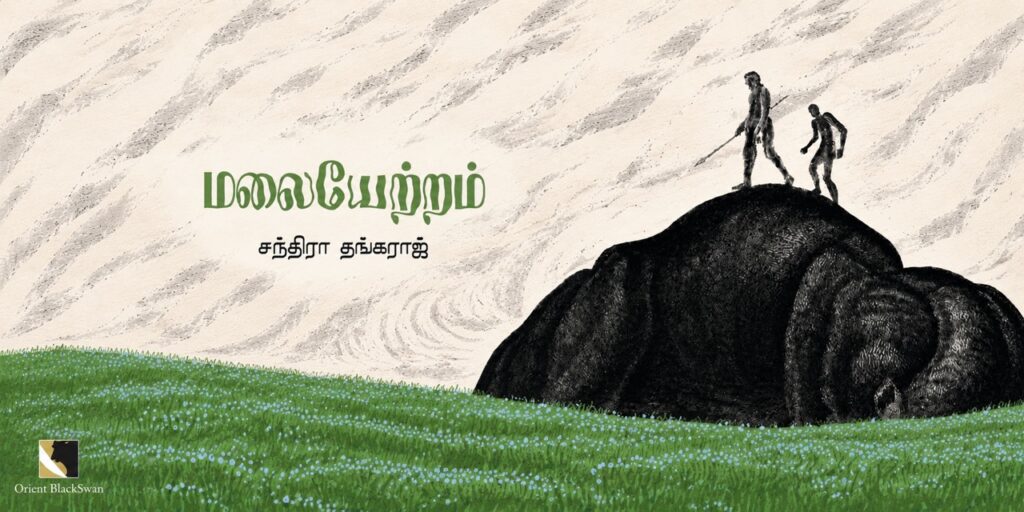
Published by Ethir Publications, the novella follows Rasapandi as he climbs the Mangaladevi mountain. The story unfolds through his memories of a troubled relationship with his father, who abandoned him at the age of seven. The narrative explores whether Rasapandi loses himself or finds himself during this journey. Set in the Theni district of Tamil Nadu, India, the novella is written in a fluid regional dialect, further rooting the theme of place and memory.
As Rasapandi ascends, the external landscape prompts him to retreat inward. Memory and reality alternate, and this relentless memory shapes both perspective and emotion—it persists on its own accord, scattering and spreading, filling emotional voids, absorbing him completely, and at times, desperately seeking to be forgotten. Rasapandi surrenders himself to it throughout the novel.
He holds his father, a figure embodying rage and vengeance, responsible for everything; for failing to protect his gentle mother, for destroying her life, and for all his own troubles. On the other hand, he musters immense patience toward his treacherous uncles out of respect for his mother, who raised him to not even express verbal violence. He even refuses to believe in their betrayal. As he climbs higher and higher, his hatred and bitterness toward his father intensify. His anger toward his father, Muthukkaluvan, known as Pulikkannan (the tiger-eyed), rises within him like a growl. Along the climb, various sights provoke him to conjure ways of killing his father. Memories of the violence he and his mother endured keep fanning that fire, preventing it from dying out.
At the same time, sweeter memories also surface—of his grandmother and grandfather, who accepted, embraced, and protected them. His grandfather, Chinnamayan, teaches the fatherless boy everything, from farming to cattle trading. Chinnamayan’s love for his grandson is so great that even on his deathbed, he agonizes over leaving him without support. His grandmother, Amaravathi, who always carried herself with dignity, loving and caring for them.
But his sorrow lingers. After his grandmother transfers her properties over to her sons, she watches her only daughter’s land turn barren because her sons withheld water rights. She falls silent, eating nothing, withdrawing into herself. He loses his mother too, the woman who raised him with fierce resolve, without a trace of anger. His only solace, who raised him with virtue, shielding him from his father’s shadow and curse, protecting and nurturing him within her very eyes. His mother, who committed no wrong, who suffered her entire life, and died in sorrow. He cannot escape the thought that the root cause of all their pain was his father.
He thinks about Meenakshi, his uncle’s daughter and the one whom he loved, that one solace that existed for him all along his youth. Even in moments surrounded by sorrow, his mind, contradictorily, retrieves pleasant memories about his father from its own archive, and suddenly, the decision he has to make seems natural. For her sake, prompted by his rush of memory, as if he had swallowed a medicine laced with a spell, he makes an unthinkable choice and ends up very naturally agreeing to go with his father.
The retrieval of memories is a deliberate narrative strategy in the story’s progression. When a character recalls past events, the story’s flow creates a gap, an interval. Within this interval, the author can reveal the story’s background and a character’s inner motivations, redefine present events, or entirely alter the prose style itself. This structure allows the non-linear, misaligned nature of real memories to be held within a framework. The storyteller uses this as an alternative route, a secret path, to lead the reader toward the destination.
Just as a painter first sketches with lines and then, with each stroke of the brush, adds colour, light, and depth, and the painting slowly comes alive, so too do memories and reality breathe life into the story layer by layer. The metaphors in this novel linger with the reader. One such metaphor is Rasapandi’s solitude, which is described as a wall; but it crumbles when he indulges in the beauty of nature. Another one is the fluttering yellow butterflies when his father is burning wood to get charcoal. As he watches, he thinks that one of them, drifting towards and then away from his father, should be his mother. He wonders: “There are a million flowers filled with nectar, so what are they searching for in these dried-out trunks?” It is as if Rasapandi’s memories, separated from his father, keep leaping back toward him again and again.
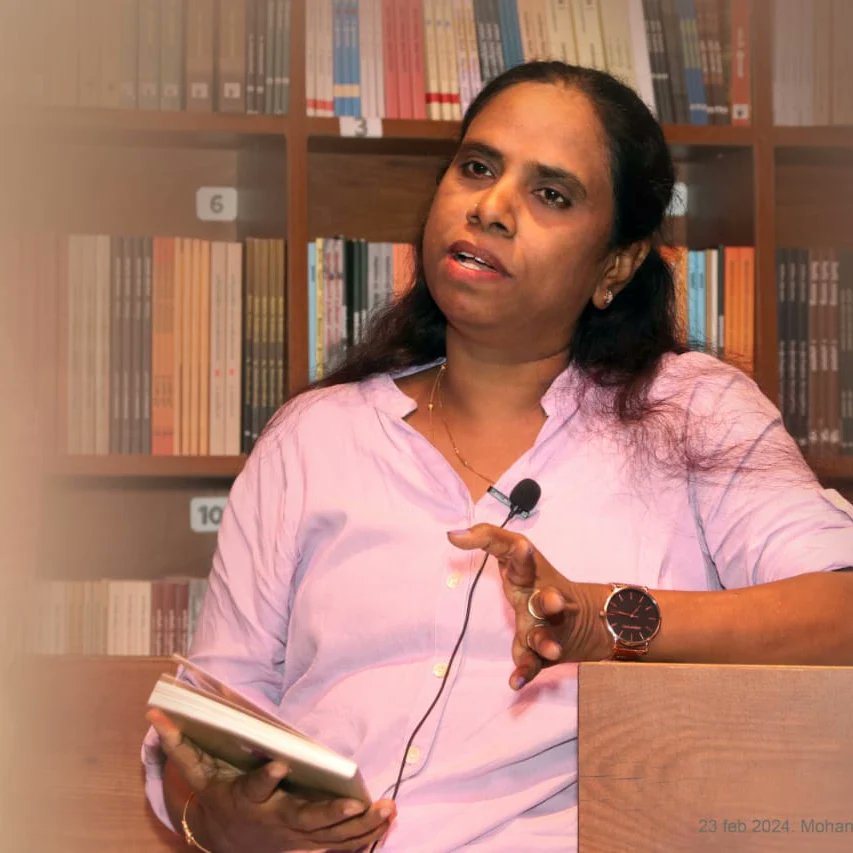
One area where the novel falls slightly short is in its rendering of the cattle world Rasapandi inhabits. In a short time frame, he succeeds in the cattle trade. To understand the weight of this observation, a reader outside Tamil literary culture needs to know about Ki. Rajanarayanan, the pioneer who brought folk aesthetics into modern Tamil literature. Hailing from a small village in southern Tamil Nadu, Ki. Ra. became one of the most significant authors in modern Tamil literature, winning the Sahitya Akademi Award and being acknowledged as the founder of an entire school of Tamil Literature called the ‘Karisal’ literature. Modern Tamil literature has been using regional dialects as an aesthetic strategy. But writing that draws entirely upon the language of a specific landscape—its idioms, folk elements, agricultural knowledge, and social records—to forge its own distinct aesthetic, beginning with Ki. Ra. In his novella Kidai, the flat, parched Karisal plain, the descriptions of the goat and sheep, with their diverse markings and colors, carry the aesthetics of his layered human characters. He proved that literature rooted in a specific landscape achieves universality not by width but by depth.
It is by this standard, not an unfair one given the tradition Malaiyetram reaches toward, that the cattle world in Chandra Thangaraj’s novella feels underlived. The animals are present, but they do not yet breathe. Thangaraj’s setting is the forested climb into the Western Ghats above Theni, an entirely different terrain, humid and dense, with a different ecology and relationship between people and animals. The cattle Rasapandi trades are not Karisal cattle; the market of Theni has its own protocols, breeds, vocabulary of assessment, and transactions that a young man who succeeded quickly in that world would experience deeply, but these aspects are not thoroughly explored.
The novel captures the turbulence of Rasapandi’s anger throughout. He constantly battles with it internally. He must either surrender to his anger, allowing the beast his mother always feared to take possession of him, or find liberation from the very chains that bind him. This peak moment occurs when he confronts the black leopard, the embodiment of the darkness within him, its glowing yellow eyes meeting him as the rage burns inside him.
Chandra argues that memory lies at the foundation of one’s sense of self. It is through memory that personal identity takes shape. The memories a person selects through their consciousness shape their present experience. Both the pleasant and unpleasant ones rise together. Memory is, therefore, both the problem and the place where its resolution should also occur. That peak moment on the mountain, where Rasapandi facing the leopard, facing himself, is where this argument becomes action. What he chooses in that instant is what the entire climb has been pushing him towards. When a person steps back and observes memories from a distance, they gain the courage to confront them directly and the freedom to move beyond them.
Seen in this light, Malaiyetram can be described as a journey of self-discovery by a man pursued by, like a rampaging elephant, both his memories and his painful past. It is a novella that reveals both the embrace and the curse of relationships.