
Compared to the Mullai (forest), Marutham (agricultural), and Paalai (desert) landscapes, the Neithal (coastal) landscape remains underrepresented in Tamil literature. Consequently, beyond general knowledge and guesswork, the life of the coastal community remains largely unfamiliar to mainstream readers. Given its rich, localized vocabulary, the vernacular of the southwestern coast can sound altogether alien to the reader.
When the Portuguese arrived on the southwestern coast of India after encountering the dark-skinned Mozambican people of East Africa, they also referred to the local population as Mukkuva, drawing a parallel based on their skin tone. The narrative expands upon this historical tidbit to dive into the rich ethnography of the southwestern coast, tracing social evolutions such as the origins of the Mappilas, a distinct Malabar Muslim community.
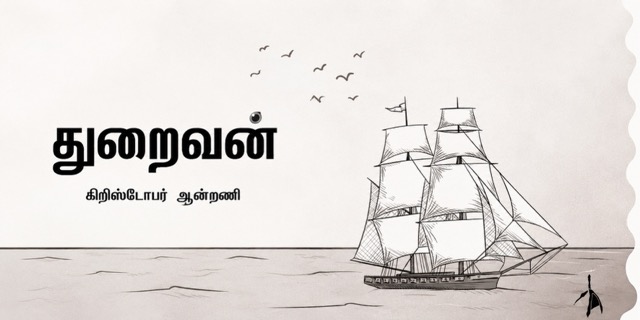
Thuraivan chronicles the history and daily life of the Mukkuvar clan, part of the Parathar community, whose ancient lineage of fishing, salt-making, and pearl-diving dates back to the Ettuthogai anthologies. This work pairs deep historical context with granular details on fish species, capture methods, and fishing technologies.
However, the dialect used here is uniquely challenging. While works like Kanni and Aazhi Soozh Ulagu also map the Neithal landscape, Thuraivan stands a step further apart from mainstream Tamil linguistics. The text introduces numerous regional terms and expressions. In my case, there were over sixty that were completely unfamiliar, humbling me and exposing a gap in my vocabulary.
The hardships of a life bound to the ocean remind us that human existence is, at its core, a relentless struggle against nature. Venturing out to sea is nothing like farming the land; it is a direct gamble with death.
Even today, despite modern technology, it remains highly perilous, but the era before navigation equipment and motorized vessels was vastly more treacherous. As the book hauntingly notes, “At night, a boat is a floating cemetery; if fate permits, they will return alive the next morning.” Yet, even when embarking on a sailing boat that appears permanently defeated, its gaping holes patched together with stitched flour sacks, physical suffering is of no consequence to these men. This book mirrors the iconic resolve of Santiago in The Old Man and the Sea: “Man is not made for defeat. A man can be destroyed, but not defeated.”
Because of a lifestyle that bears daily witness to the grandeur, mercy, and cruelty of nature, these men have possessed, for generations, a personality filled with faith in God, a sense of adventure, and comradeship and trust toward fellow humans. They are like Hemingway’s Santiago, an aging Cuban fisherman, says these words during a grueling, multi-day battle with a giant marlin. Viewing the noble creature as a “brother,” he copes with the emotional toll of the kill by shifting his perspective to the cosmos—expressing gratitude that humans only have to hunt earthly creatures, rather than the stars, to survive who thinks: “I am glad we do not have to try to kill the stars. Imagine if each day a man must try to kill the moon, he thought. The moon runs away. But imagine if a man each day should have to try to kill the sun? We were born lucky.”
The waves crash down without pause; mighty, black elephants locked in combat within the deep. In this oceanic battle, the victorious beasts hurl the defeated toward the shore, where the blood of the fallen spreads across the sand as a thick, white foam.
From the surf break to the water’s edge, the white foam churned up like a great waterfall brush against the shore, mimicking the pale border of a young girl’s dark blue silk skirt. Out in the Arabian Sea, the red hue of schools of shrimp swimming backward catches the light, turning the sun a brilliant gold as it ascends over the eastern corner of Idappadu village. Meanwhile, rainwater heavy with red soil streams through the gaps between coastal houses, staining the beach with a blood-like slush. For the fisherman, the sea is not just a view; it is an entity that completely encompasses all horizons.
Thuraivan provides a rare, microscopic view into the technical realities of the coastal fishing trade. It pairs architectural descriptions of catamarans, vallams (canoes), and plywood boats with practical breakdowns of specialized gear like the Mayakka device, Karamadi (shore seine) nets, longlines, and silk-thread nets. More than just technical, the text profiles a vast array of marine life ranging from regional fish like Kozhuvalai, Therachi (ray fish), Katta Komban, and the leaping Aeva, to whale varieties like Madi and Velludumbu, while carefully distinguishing between Olaikanavai (squid) and Thottukanavai (cuttlefish). It documents intricate indigenous strategies, such as using shore crabs as bait to catch larger crabs that eventually trap squid, utilizing dolphin meat to hunt sharks, and maintaining boat engines, all while seamlessly bridging old world knowledge with the modern mechanics of GPS navigation points.
Every hand required to launch the vallam into the surf, harvest the catch, and return safely is introduced within the first two chapters. The narrative strictly eschews contrived efforts to artificially elevate its craftsmanship or aesthetic appeal; consequently, the characters and their day-to-day realities emerge in a thoroughly organic and authentic manner. There is a fascinating linguistic irony at play here: much like inlanders refer to a deadly cobra as Nallapambu (the good snake) out of reverence, coastal communities uniquely dub the sea’s fiercest predator Nallameen (the good fish).
“We ourselves are beggars. A beggar must beg and give to another beggar.”
“Back then, I drank to show the next man that I was rich. After that, I drank because of the burning sorrow given to me. Now, I drink so I don’t feel the pain of cancer. I can’t give this up anymore, child.”
Dialogues like these unfold in a dense, uncompromisingly raw vernacular. They ground the narrative completely, leading up to vivid, unforgettable imagery; such as when Bartholomeo balances upon his tossing catamaran, standing as effortlessly as if he were balanced on the head of a striking serpent.
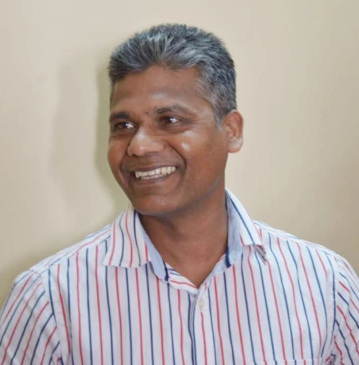
While the blending of literature and ethnography might result in a few structural flaws as a novel, the author notes in the preface, the detailed insights into the fishermen’s history, daily lives, and fishing techniques guarantee a compelling reading experience. We couldn’t agree more.
Since the novel aims to give a community with varying degrees of literacy and literary background their own lives back in print, its simplicity is clearly a deliberate and necessary choice. To enhance this accessibility further in future prints, a brief appendix translating the regional dialect into standard Tamil, accompanied by diagrams or illustrations of the local fish species, nets, and unique fishing techniques, is an invaluable addition.
Though a book’s value can be measured in many ways, Thuraivan opens a window onto the southwestern coast of Tamil Nadu, revealing a profound way of life hitherto unknown to the general Tamil reader.