
Displacement is cruel in more than one way. The obvious version is accompanied by violence, bloodshed, even annihilation. The other comes more slowly: an exit that isn’t salvation, but a mere escape where parents sell their last possessions to send their child away. Yet the outcome can look eerily similar: uprootedness, the loss of a place to belong, and ultimately the erosion of memory. Sri Lanka’s civil war offers a recent, devastating example for both versions of displacement, in which civilians are battered by violence from all sides, sometimes by the very side that claims to protect them.
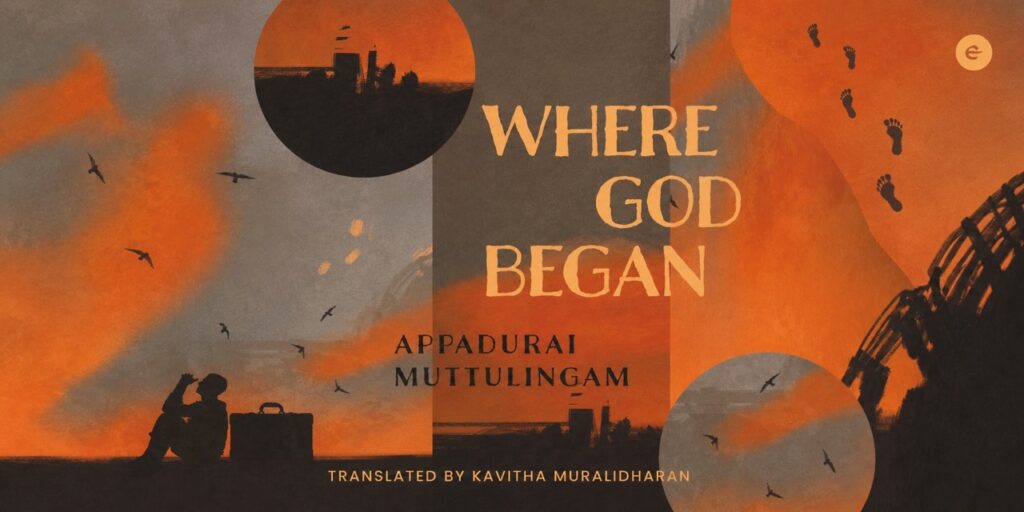
A. Muttulingam, Sri Lankan by birth and shaped by the testimony of those who lived through this displacement, writes about this second kind of exile with a steadiness and an eye for detail that only a disciplined writer can maintain. The result is Kadavul Thondagiya Idam (Where God Began): a novel with an exceptional gravity regarding human verities and an unexpectedly sharp streak of humor.
The story opens with Nishant, a nineteen-year-old, being uprooted from Sri Lanka to the literal opposite side of the globe, Canada, as his parents trade their last plot of land for his survival. The trip, of course, is anything but direct. Passed from agent to agent and smuggled across borders, Nishant endures punishing stretches of weather, hunger, and fear. Along the thirteen-year arc of this journey, he encounters a cast of souls “living in limbo,” each with a distinct set of habits and hard-earned philosophies of their own. Lives are briefly shared and then lost. Muttulingam turns that accumulation of encounters into a kind of necklace: different beads, each one singular, with Nishant as the thread that connects them.
The novel’s most profound strength is that none of these characters are reduced to a single note. There is a Nishant who, early on, refuses to rinse his own plate, yet later works the dish pit in a diner. Eshwari, a woman he despises for having an affair while traveling to join her husband, ends up offering the very breakthrough he needs at the book’s end. Within this framework of survival, the novel’s greatest vitality lies in the sheer range of humanity that manages to bloom within it. The characters resist tidy interpretation; they are not just victims, but people who fill their lives with small adventures and defiant joys.
Satyan, a friend Nishant meets in Germany, lives by a motto as blunt as it is functional: deal with all happy matters today, everything else can wait until tomorrow. Jayakaran, an adrenaline seeker, tells stories of close calls that leave him looming larger in Nishant’s eyes when he leaves the room than when he entered. Then there is Pushpanathan, who, despite his fierce pride and a stint in jail, makes the oddly domestic demand that Nishant bring his daughter some KitKats. In Muttulingam’s hands, fierceness, foolishness, and tenderness aren’t contradictions; they’re the full inventory of a person.
Also, throughout, Muttulingam denies the reader the usual consolations. There is no cathartic weeping, no stirring speech, and no triumphant restoration of dignity. That restraint doesn’t suggest repressed sorrow. It suggests a world in which grief has become an atmosphere, simply what people breathe. Instead, the characters build private philosophies sturdy enough to keep them moving.
Take Sabanathan, who missed medical school by a single point and spent his decades in Canada washing cups. When told that a former classmate, who used to compete over grades with him, is now one of London’s top neurologists, Sabanathan is unbothered. “So what?” he says. “He may be one of the five best doctors. I’m one of the five best dishwashers.”
A woman the novel calls Karpagatharu Vilas Aachi is a mother for exactly one hour; her newborn dies before the hour is up. She flees, leaving her husband behind, and later receives word of his death from Colombo in a phone call that contains only four words: “He died; that’s all.” Forged by such loss, she offers Nishant a philosophy hammered into shape by survival: a sari soaked in water will dry in four hours if you leave it alone, just like grief. Earlier in the same conversation, she describes watching an injured moose on a Canadian highway draw an ambulance and fifteen minutes of stopped traffic. A country’s progress, she suggests, is measured not only by how it values human life, but by how it responds to any life. She never connects that observation to the call from Colombo. Muttulingam trusts the silence to do its work, and it does.
Perhaps the most piercing figure, however, is Nishant’s Ukrainian landlady. She possesses everything the refugees lack, a home, money, and festivities, yet her life is staged against its own kind of emptiness. She shares her table and her compassion with her tenants, even welcoming Nishant back years after he deceived her. She seems to understand that dispossession isn’t always about geography; it is a universal human predicament in which only the form varies.
That is the novel’s political essence. It works through what is withheld rather than what is declared. No government is named, no army singled out, no side officially acquitted or condemned. Politics live in juxtaposition, in the pressure created by contrast and by what stands beside what. When a character known as Magistrate Annan observes that anyone who witnesses injustice and does nothing carries a portion of the blame, the line lands like a ruling. Not because Muttulingam argues his way to it, but because the novel itself has supplied the evidence.

The novel is not without its concessions; its origins as a popular magazine serial occasionally show in chapters driven by mass appeal rather than the story’s internal logic. Strong characters sometimes exit before fully revealing themselves. Yet these are worth living with, as the book’s power is not so fragile that it depends on seamlessness.
What remains beyond doubt is Muttulingam’s attention to the inner lives of those pushed to the margins, people whose sense of right and wrong has been scrambled. The book’s best scenes press on the question of what we become when everything stable is stripped away, without ever needing to spell it out.
Amid the blunt sufferings, Muttulingam reveals these sudden pulses of poetry. Be it the final blackout, where Nishant is left in the dark holding a key to a door he cannot see, or at the beginning, when his mother, the one who pushed him away, keeps circling back to him in small, involuntary ways, through acts like the cooking of his favorite meal. She never says she misses him; instead, she soothes herself with a fact that feels like a mantra: “You and I shared one body for nine months.” It is a line of pure poetry, confirming that, at his best, Muttulingam is a writer of the first order.