
Histories of wars usually record victories and defeats, which side prevailed, which territory changed hands, and what political objectives were achieved. But wars leave behind lingering questions. The dead appear first as news, then as statistics, and finally as a casualty count in a war database. Who, exactly, were the people who disappeared and died in this war? What did they die for? Do their losses mean anything at all?
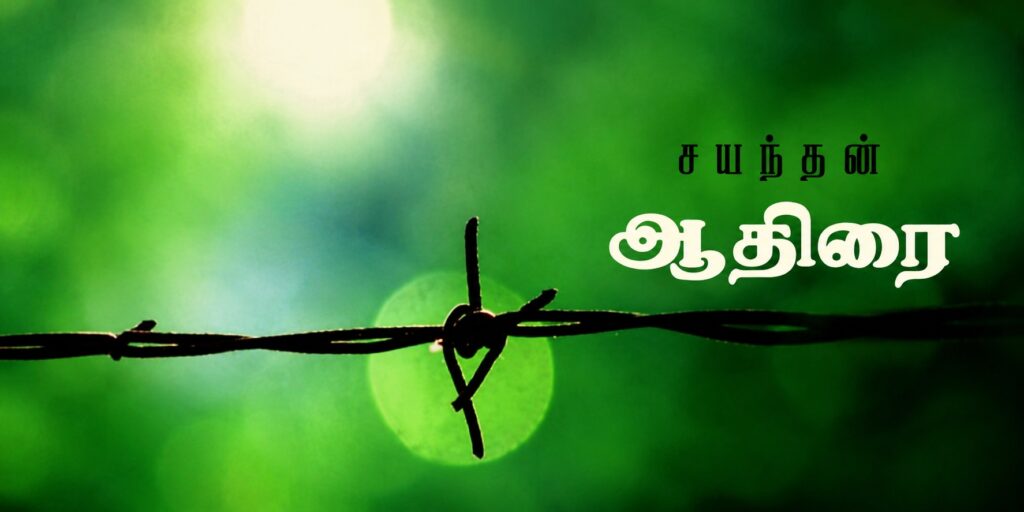
Sayanthan’s novel Athirai refuses to give easy answers to these questions. Instead, it delves into the lives of Eelam Tamils and ‘Malaiyaha’ Tamils (also referred to as Plantation Tamils) against the backdrop of Sri Lanka’s Sinhala-Tamil civil war, from 1977 to 2011. Were the lives lost across three decades just a statistic? Does dying for a cause make death more meaningful? The novel searches for meaning in the lives of communities who lost generations and asks what, exactly, remains in those who survived.
The novel opens in 1991, when Lechumanan, once a member of the Tamil Tigers movement, is seized by the Sinhala police and subjected to brutal torture. His father was among the Malaiyaha Tamils displaced from the hill-country estates during the 1977 riots. The novel weaves the lives of two Eelam Tamil families – Sangili and Meenakshi’s family, and Atthar and Chandra’s, charting their many displacements, and their survival in a landscape saturated with war.
The Malaiyaha Tamils were brought to Sri Lanka as plantation laborers by the British colonial administration, and their labor built the island’s economy. When Sri Lanka gained independence in 1948, they were refused citizenship. Most were deported to India. Those who remained lived stateless, landless, and suspended – left to die, left to disappear. “My grandfather was born on this very estate,” one character laments. “We performed his final rites in this land. Why would I go anywhere else?” Through their predicament, the novel poses a persistent, uncomfortable question: what is one’s land? The novel implicates the famines caused by colonial exploitation, which drove many people to accept indentured labor, as well as Sri Lanka’s geographic proximity to South India, a circumstance that was ruthlessly exploited by the colonial administration.
The novel does not portray the Sinhala side, nor does it offer a detailed account of the Tamil Tigers as an organization. What it does instead is more intimate and more demanding: it renders the wartime lives of Eelam and Malaiyaha Tamils from within—their anger, tears, grief, and losses, their daily experience of normalized violence, and despite all that, their obstinate will to live, and for some, the willingness to die for it. The experiences of Eelam Tamils differ from those of the Malaiyaha Tamils. For the former, the war is violence upon the very land they own. For the latter, it is one more dispossession, one more uprooting added to centuries of others. The novel also touches upon the caste fractures running between these two communities, and the differences between Christians and Hindus within the Eelam Tamils. Sayanthan is careful to show that even among survivors, the shape of loss differs.
There is forcible execution of the body and execution of identity through joining a collective. The novel’s most vivid passages follow the young, teenage Lechumanan on hunting expeditions into the forest with Atthar and Sangili. In regular times, the city is safe, and the forest poses danger. In wartime, this is reversed: the forest becomes a refuge, luminous with the beauty of nature, while the city poses threats. These hunting scenes are where Lechumanan is simply, briefly, a boy. After he is dragged away by the Sinhala police and tortured, he disappears. We never learn what becomes of him. Meanwhile, the older Mayilkunjan, knowledgeable of the forest since his childhood, has a different path. Caught by the army along with others, he watches a soldier dress a youth in a green undershirt to photograph him as a militant, before killing him and throwing his body out of a helicopter. After this, Mayilkunjan joins the Tigers, navigating the forests for them with great precision. The jungle becomes a killing ground. As he lies dying, fear grips Mayilkunjan that he might not be able to see the war’s resolution. The same fear and hope lingered in the Tigers, who had chosen to destroy themselves in the name of what they believed.
Across the novel, Malaiyaha and Eelam Tamil youth go missing. Their futures blur until there’s nothing left behind. Their families ask about them relentlessly until even that inquiry dissolves into silence. Schooling happens in the gaps between violence and displacement. Without proper education, young men have almost nothing on offer except agricultural day labor. We saw earlier how Letchumanan goes missing; those who remain assume he joined the movement. Vellaiyan, son of Sangili and Meenakshi, disappears when the family is most vulnerable, in the aftermath of Sangili’s death. Those around them cannot reason why they leave, or perhaps they do not have the time or luxury to pause, amid surviving a war, to examine their reasons. Vellaiyan does join the movement. A fragment of shrapnel lodges in his hip; he returns home not able to bear the mental and physical pain, the years of his youth consumed. Post-traumatic injury leaves marriage and domestic life affectless, impossible to inhabit emotionally. Something shifts only when his children are born. He wants, desperately, to keep them alive. There is no money to buy passage abroad; the only work he can get is clearing landmines. Sangili and Meenakshi also have a daughter, whose husband disappears, his fate similarly unresolved. In a civil war, it is not only individuals who go missing. It is an entire generation’s education, youth, livelihood, love, family life, time, happiness, and then, for many, life itself. Sayanthan renders the psychological damage of civil war on society, especially on children who grow up watching the dead and injured, and does so in a language so realistic in style and tone that it intensifies the impact.
Death skips over some and takes others as collateral damage. Sangili’s brother Natarajan is caught in a massacre near Othiyamalai, where the army encircles the village and opens fire. People are killed before they can understand what is happening or why. In a civil war, Sayanthan shows, the response to violence against one party is always directed at the most defenseless link in the chain. Sangili’s rage at the movement – “You lit fire to this land that was bleeding for its own people… How many lives has it burned?” erupts over Atthar. Sangili never joins the movement. His death, when it comes, is almost absurd in its ordinariness, by a bull’s attack. Yet his nephew, Natarajan’s son, dies a martyr’s death in the movement, and his own son Vellaiyan joins it. The irony of their fates is quietly devastating. In a landscape where death is everywhere, the survivors feel, hovering unnamed behind everything they do, a formless, unearned shame at being the ones who remain.
The novel is unsentimental about class. “It’s the children from struggling families who come here,” someone observes of the movement’s rank and file. “The children from well-off families are at the movement’s pass offices, arranging to leave the country.” The Tigers extracted diaspora funds from families whose sons or husbands had gone abroad – hundreds of crores, the amounts varying by country. The novel records this without flinching. Former cadres speak with impotent bitterness of the lakhs paid to agencies for passage out. Asylum and refuge, the novel observes, begin as expressions of human solidarity and become industries. The only escape from the war is taxed as tribute to the war itself.
Atthar, the communist who speaks of collective ownership, remains a spectator to the end – sympathetic to the movement, believing in the people, but never joining, persisting as a kind of witness. Chandra is the moral center that the novel builds up. She becomes the school’s deputy headmistress as she approaches fifty, and speaks against weapons, against war, against the logic that produces both. She watches schoolgirls leave for the movement and witnesses young men shot in the streets as traitors, and at a certain point finds herself grateful, for the first time, that her womb never opened. “The movement may call it heroism,” she finally says, “standing until the end and dying. But you cannot demand that people who want to live climb onto a funeral pyre.” In the final battle, Chandra is killed. Atthar dies with one eye still open, his body draped over hers. Those who find them remember only this about him: the barber man, the one who married the Vellala woman. Among war’s cruelties, one is this: to die unknown, without kith or kin, unmourned, with no one left to remember you ever lived.
The novel captures the cycle of new life that follows death. After the Othiyamalai massacre, it is the elderly Aachimuthu who delivers Valliyaal’s baby after a long, complicated labor. The girl born is named Muthu in her memory, and later, Muthu marries Vellaiyan, Aachimuthu’s grandson, who is named after her husband. The Ithi tree (Sri Lankan fig) is used throughout the novel as a symbol of the island itself. In Sangili’s grandfather’s time, it received offerings after a hunt. In Sangili’s time, it was a mature tree, its customs and rituals deep-rooted; families would make pongal (sweetened rice) to offer to it. During the civil war, a storm destroyed it. But beside the fallen tree, a new sapling rises, and at the novel’s end, Vellaiyan’s daughters offer pongal to the young Ithi tree. What remains after the war is not only grief. Memories and traditions remain, and the will to live again lingers. Through the Ithi tree, the novel shows that creation follows destruction naturally, that life continues beyond what war and grief can extinguish.
While war leads to inevitable demise for many, it is important to never consciously forget the impact of others. Through forgetting, we erase – enforcing disappearance. Athirai is both the novel’s title and the name of one of its women, representing Lord Shiva’s birth star—luminous amid the dark. In the movement and in society, it is the women who shine brightest. Vellaiyakka embodies this. She manages the estates alone, survives the army’s violence, joins the movement, and loses a leg, yet builds a family life for herself and becomes a nurse, tending the wounded during the war. At the end, she blows a conch signaling a new beginning. The young women sea-fighters, like Athirai, sacrifice their lives in the hope of victory, their fearlessness and courage giving dignity and meaning to deaths.
In the final battle, as civilians attempt to flee, movement cadres block them, warning that the army will use them as human shields to advance. When people push through anyway, running with their children, the cadres open fire. The novel raises the question: for whom, exactly, is this war being fought? The portrayal of war sharpens further in the Eelam Tamil dialect. Sayanthan’s words pierce like shrapnel: “The so-called safe zone was declared precisely to concentrate the scattered people in one place and kill them all at once.” And: “If you don’t dare to watch your children die, pray to God that you die first. That is what I am doing.” The belief that the movement would bring dignity curdles into something else entirely. The people who once looked to the Tigers for deliverance now curse the cadres openly: “If you don’t want to be caught by the army yourself, you should bite the thing swinging around your neck.” “You will rot.” Faith and contempt, it turns out, are separated by the span of a war. The novel questions the very purpose of an organization that operates without incremental goals, without reckoning with the condition of its own people on the ground, without ever considering compromise. The pages of the final battle cannot be read without tears.
One of the novel’s greatest strengths is its sensuous prose. The flora, fauna, and terrain of Sri Lanka come alive in the novel’s Eelam Tamil – ponnakar, kooma, thavittai, pombar, ozhungai, velikadhiya, and much more, rendered in their native names with striking beauty. A glossary of Eelam Tamil words appended to the book would serve Tamil readers worldwide. There are, however, limitations worth mentioning. Occasionally, the narrative steps back from its characters to deliver information, passages that read less like lived experience and more like reported fact, as though the novel is ensuring nothing important goes unrecorded. However, the author’s desire to leave no significant event undocumented is understandable, even admirable.
A more significant limitation is this: in Athirai, the Sinhala side remains a military force, a weapon, and a two-dimensional representation. In a novel that chronicles more than thirty years of devastation with such scope and moral seriousness, the face of the other side is not shown enough, which might have raised it to a different order of achievement.
How does humanity move forward? Does bearing witness to human suffering, and asking what conditions caused it, prevent such wars? In the case of the Sri Lankan civil war, the blood and tears of ordinary people, their unbearable suffering and grief, failed to summon meaningful international intervention. Many lives were lost. Partly because powerful nations decide whose war deserves their attention. Asylum granted by a few countries can never be enough and common people dying in some forgotten corner of the world remain merely a number. Only a few kilometers away, in a peaceful nation, Tamil-speaking children go to school, citizens vote their leaders in and out of office, and lead ordinary lives. Citizenship and the dignity of life are the most basic entitlements of any human being. For those denied even these basic rights, the lives lost for the cause are arrows fired with the hope of resolution – brave and devoted but ultimately defeated. Arrows of sacrifice shot into a darkness that never yielded a result.
Athirai offers a total reckoning with the Sri Lankan civil war across its full span of decades — the instability that persisted long after colonialism ended, its consequences, the communities it displaced, the citizenship it denied,and the inherited burdens that continue to press on generations today. The novel raises questions and provides some answers, but also leads readers to reflect on the questions of humanity, and allows for the dead to share their stories. For readers who have known the Sri Lankan war only through news reports, Sayanthan brings them face to face with its people, through the many shades, depths, textures, and flavors of the language itself, through the shock of encounter. In doing so, he ensures that these lives are remembered as humans and not just mere numbers.