
In Jeyamohan’s novel Neelam, Puthana is drawn as the completeness of motherhood itself, ears that existed only to hear a child’s babble, a voice that existed only to soften and melt before them, a being who had never, not for a single moment, been anything other than a mother. And yet it is from within this very motherhood, not in spite of it, that she walks to Gokulam to kill. The milk and the poison flow from the same breast. The demon that revels in sacrifice and dances in frenzy does not replace the mother, it rises from inside her. This is what Indic tradition has always known: that the capacity for violence is not the opposite of a mother’s care, but its deepest extension. The force that nurtures and the force that destroys to protect its own dharma are not two natures but one. It is a primal energy that transcends race, language, time, culture, and social codes, and continues to endure. M. Navin’s Peichi emerges as a powerful work that places this central vision before us.
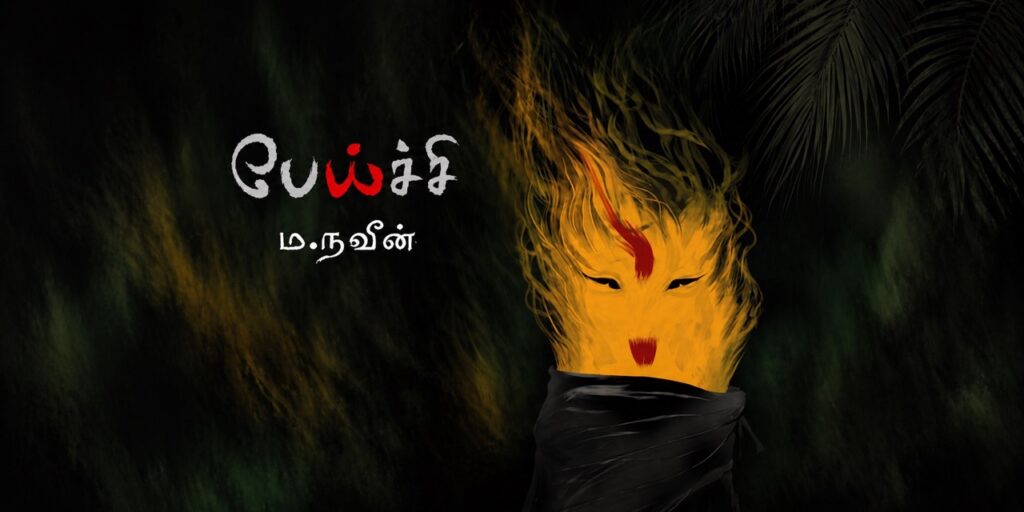
A novel, at its core, proposes a foundational vision or a counter-vision. It engages with the many layers of life, examines them, and gathers them into a form that possesses both density and inner expansion. Jeyamohan, who has shaped much of contemporary Tamil literary thought, holds this as the novel’s essential demand. Peichi, the debut novel of Malaysian writer M. Navin, who is also the editor of Vallinam, meets it.
Set against the backdrop of illicit liquor deaths in the Lunus estate of Malaysia during the 1980s, the novel traces the lives of migrants from Tamil Nadu who seek to root themselves in a new land. Through the stories of three generations, it portrays how their folk deities, traditions, and social codes adapt, transform, and yet endure within a changed landscape and time. The people who clear forests to build plantations, who move from estates to labour lines and then to urban apartments under the pressure of economic change, attempt to claim this land as their own. In this struggle to belong, the novel unfolds as a series of encounters between differing life-worlds and perspectives.
The narrative moves across three time periods, 1981, 1999, and 2019, shifting back and forth across time. It begins in 1999, in Ramasamy’s house, with rituals and healing performed for Appoy, the grandson of Olammal, and concludes in 2019, where that same house has become a shrine for Peichi. There, Appoy and his wife Malathi come seeking a child.
Olammal and Ramasamy stand at the heart of the novel. Around them gather a vivid constellation of lives. Ramasamy’s father Kopperan and mother Kaathayi, Olammal’s husband Maniyam, her daughter Muniyamma, and her grandson Appoy, along with his dog Karuppan. Alongside them stand the Malaysian forests, the rubber trees, the kampong, and the dense green world they inhabit. Together, they bind the reader to both character and setting with emotional force.
Kopperan, once a healer in a hill village in Tamil Nadu, is a devout believer in Peichi, whom he sees as a compassionate mother. He marries Kaathayi, who comes to him for treatment. When their first five daughters die mysteriously soon after birth, grief drives him to learn more about her past. There he encounters another face of Peichi seated with an infant clenched between her teeth. Fear takes hold of him, and he begins to see Kaathayi herself as that terrifying presence. When their sixth child, Ramasamy, is born, he flees with the infant, travelling across lands until he reaches Malaysia. In the forest, a vision of a king cobra appears before him. He receives it as Peichi’s command and resumes his healing practice.
Ramasamy, mocked for his femininity from childhood, grows up in isolation. Yet he inherits his father’s knowledge of herbs and healing, and through it earns a place for himself in the world.
Olammal arrives in Malaysia as a child, fleeing famine with her parents. On the journey, she watches her father’s body, dead from illness, being cast into the sea. The sight leaves her with a lasting fear of it. Beginning as an orphaned girl, she builds her life through labour alone. Betrayed and made pregnant at a young age, she eventually reaches the Lunus estate, where she finds acceptance among its people and friendship in Ramasamy. She gives birth to her son Kumaran and, through relentless effort, establishes her own home and land. Kumaran, though developmentally challenged, remains for her an unending child. She accepts this without sorrow and raises him with quiet joy. Later, she marries Maniyam, gives birth to Muniyamma, and after his death raises her daughter alone and sees her married.
Maniyam rejects his hereditary occupation and leaves his native place. He learns silambam under a guru and later joins an estate under a planter. In time, he arrives at the same estate where Olammal lives, marries her, and begins a life there. His outward qualities shape him into a leader among the youth. He is brave, disciplined, devoted to his guru’s word, attached to Periyar’s ideals, and committed to the welfare of the workers. Yet the desires within him lead him toward betrayal. They drive him to wrong his employer and estrange him from Olammal. They also lead him into violence that ultimately becomes the cause of his death.
Ramasamy, who comes to understand his own femininity as an expression of maternal instinct, develops a deep attachment to Olammal. Seeing in her the form of his mother, he becomes capable of anything for her. That attachment leads him into acts of violence, believing them to serve her well-being. Unable to bear the weight of guilt, he finally ends his life by leaping into the waterfalls of Boonia Kampong.
Appoy, Olammal’s grandson, and his dog Karuppan introduce another dimension to the novel. Through the boy’s gaze, the Malaysian forest opens itself in detail. The herbs, the birds, the living textures of the land are revealed one by one. His curiosity draws him to observe even the smallest creatures. A worm moving through the soil, an insect curling in fear, a butterfly drawing nectar. In play, he strikes down a bird with his sling. The sight of its blood fills him with remorse. In that moment, he comes to understand compassion. Navin often adopts a simple and compressed mode through the child’s perspective, allowing the reader to extend and deepen the meaning.
Alongside them stand many other figures. Chinni, who sees only profit in brewing illicit liquor. The schoolteacher who drinks to numb his pain and is consumed by it. Sambu Sami, who moves from Periyar’s rationalist movement to become a priest of Peichi. Thok Guru, who rescues Ramasamy from suicide with a single question that restores proportion to his despair. Each of these figures strengthens the narrative.
Taken together, these lives form more than a cast of characters. Peichi presents a central vision through them, stages the conflict of differing mental worlds, and narrates with a strong sense of history. In this, M. Navin’s debut possesses all the qualities of a fully realized novel
Beyond this, the work opens into several compelling layers. It reflects on the periods of British and Japanese rule. It shows how prohibition was used to displace traditional liquor and introduce Chinese arrack. It observes the relentless labour of the Chinese community and their unwavering focus on wealth. It registers the impact of Periyar’s words to the Malaysian Tamils, urging them to see this land as their own. It traces shifts in popular imagination, seen in the movement of youth from M. G. Ramachandran to Rajinikanth. These strands are unfolded with care, adding richness to the narrative.

Even as the story moves back and forth across time, the clarity of narration remains intact. The reader is not confused, but steadily carried forward. In this, Navin succeeds with quiet assurance.
Each character, shaped by a distinct life history and a personal sense of justice, comes into conflict with others. Yet what binds them all is attachment and desire. A father’s attachment leads Chinni toward actions that cause many deaths. Desire drives Maniyam toward betrayal. Maternal attachment draws Ramasamy into violence. In Olammal, rising as Peichi, attachment to all that she has created becomes the force that destroys it.
From another perspective, the novel may be read as a gathering of life’s contradictions. Kopperan crosses the sea to preserve his lineage, yet his son lives in isolation and dies alone under the burden of guilt. Olammal, who builds a life that extends beyond the walls of a house into land and community, ultimately destroys all that she has created. She kills Chinni for causing deaths through liquor, only to later drink that same liquor and cut her own throat before the very stone where Chinni was killed. In the novel’s most striking turn, Chinni herself transforms into Peichi in the form of that stone, and the same liquor becomes her offering.
Even Malathi, Appoy’s wife, who lives with a childlike ease, reveals this latent force. Though she is at first afraid, she later slaughters a rooster for the sake of her child. In that act, she reveals the Peichi within her.
Standing witness across these three generations is the great rambutan tree. It has grown there, bearing silent testimony to all that has unfolded. It stands still, as though waiting to witness the Peichis yet to come.